- roof area must be properly cleaned off debris and saw dust before installation of the metal roof. Otherwise, there is a risk of capillary action.
- In order for the PREFA roof covering to fulfill its function, PREFA roof coverings may only be walked on by competent persons. In order to prevent technical or visual damage to the roof covering (e.g. damaging seams, indentations) by third parties, additional measures must be taken, such as walkways.
- The length of prefabricated flashings should not exceed 3,000 mm. Do not make a firm connection at the joints, as expansion and contraction will be restricted otherwise.
- For edgings and trimmings only use PREFA supplementary coil material that matches PREFALZ. This is the only way to ensure colour consistency in the long term.
- In order to avoid colour differences, batches should not be mixed on individual surfaces.
- Directional arrows are printed on the back of the PREFALZ coils. To achieve a uniform appearance, ensure that the direction of the arrow is uniformly aligned on each surface.
- You will need longer grooved nails (e.g. 2.8/40) for PREFA coverings over thicker layers of bitumen or thicker separation layers.
- There is no need to paint over or touch up scratches on coil-coated aluminium products due to the corrosion resistance of aluminium. When touching up scratches, there may be colour differences due to different paint qualities of the touch-up paints/pens.
- The processing temperature should not fall below 0° C.
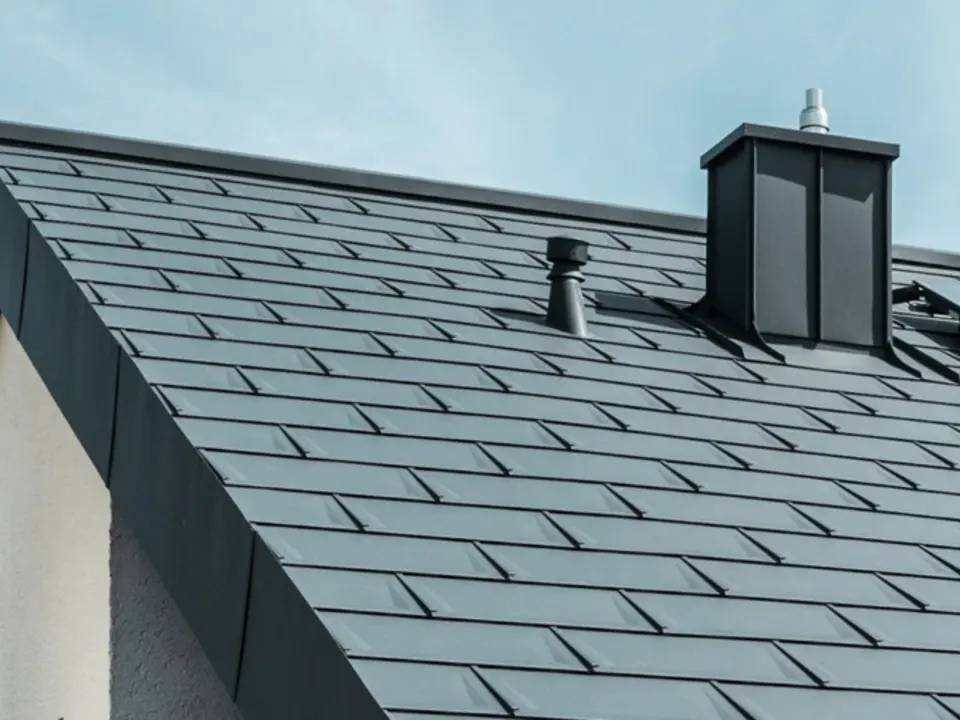
- For all built in parts and roof penetrations, PREFA prefabricated accessories must be installed that are matched to the covering material. Verges, hips and ridges as well as roof penetrations must be installed professionally.
- Minor colour deviations are not a quality defect. Small scratches are possible due to processing and do not affect the function and durability.
- Coverings and cladding made from PREFALZ are “non-self-supporting profiles” and do not have an absolutely flat and even surface. This is a type of deformation typical of thin sheet metal. Slight quilting or oil canning are characteristic of all thin sheets and do not represent a defect.
- Ensure compliance with Health and Safety Regulations prior to the installation works.
- Use a deck aid and take all other safety measures into account, such as roof anchor hooks that may be required.
- In the case of powder-coated products, cracks and damage to the coating must be expected during forming (e.g. expansion of pipes).